

Understanding Cannabis Terminology: Industrial Hemp and Oils
Understanding Cannabis Terminology: Industrial Hemp and Oils
As a chemist and medical doctor I found the lack of proper nomenclature to be a hindrance in defining how cannabis preparations can help treat medical disorders. For the consumer, it’s very important to know and understand what these terms indicate.
The most compelling reason is that many patients seeking medical applications for their particular condition need to know if they are taking the right medicine for the right job.
For example, what’s the difference between hash oil, cannabis oil, Rick Simpson oil, hemp oil, hemp seed oil, and CBD oil? Can they all treat cancers, what about PTSD, insomnia, or skin rashes? When do we need THC in our preparations, when don’t we? We’ll cover industrial hemp products today, followed by CBD oil in my next article. In a separate piece I’ll review cannabis oil, what it is, why we need it, and how to make it.
INDUSTRIAL HEMP
From the Hemp Industries Association website:
The term “Hemp” refers to the industrial use of the stalk and seed of certain varieties; Cannabis or “marijuana” refers to the smoking or ingesting of the flowers and leaves of certain other varieties.
Psychoactivity requires high levels of THC — Tetrahydrocannabinol. Cannabis contains 5%-10% THC
[or much more]
. Industrial hemp contains only .3%-1.5% THC, yet has a higher concentration of Cannabidiol, or CBD, which maintains an inverse relationship with THC and tends to moderate its effects.[ref](http://www.thehia.org/faq7.html) 06/10/2015[/ref]
Hemp is a schedule 1 substance meaning it has a high abuse potential with no medical uses. Yes, I’m laughing too but that’s what happens when uninformed politicians make our laws. You could smoke hemp all day and have nothing to show for it but kennel cough and a migraine.
The seed products are legal in the US and UK. There are hemp seed products sold as food, they are: whole seed, shelled seed, seed oil, seed meal and presscake. In addition the plant provides non-food oil as lubricants, and many forms of fiber for making paper and textiles. It’s most underutilized application is for fuel. The hemp landscape is slowly changing as several states have legalized growing hemp in the US but it’s off to a glacial pace.
THE CONFUSION
The main problem is the confusion between hemp oil and cannabis oil which has emerged as states passing medical marijuana laws allow for the use of varietals of marijuana that are low in THC and high in CBD.
One example is the varietal called Charlotte’s Web which is quite high in CBD and low in THC. It was bred to be high in CBD for treating “status epilepticus” (seizures that do not respond to conventional therapy). It is not psychoactive. You may or may not achieve success treating seizures using simple CBD oil verses this product.
HEMP OIL, CANNABIS OIL, CBD OIL
Consumers often confuse hemp oil with cannabis oil and with CBD oil. CBD and hemp oil are both much lower in THC and contain CBD. CBD oil is supposed, by definition, to be much higher in the CBD fraction than any other type of oil, hence its name.
Hemp oil sold in stores is hemp seed oil. Rick Simpson calls his cannabis oil “hemp oil.” See how easy it is to get confused?
CBD is not a product or component of hemp seeds, and labeling to that effect is misleading and motivated by the desire to take advantage of the legal gray area of CBD under federal law.[ref]http://www.mintpressnews.com/hemp-oil-versus-cbd-oil-whats-the-difference/193962/) 06/10/2015[/ref]
With the market ablaze, and growing at an alarming rate, it’s crucial that consumers know the difference between hemp oil and CBD extracts. Eric Steenstra, executive director of Hemp Industries Association, had this to say:
Though hemp oil does contain low levels of CBD, typically less than 25 parts per million (ppm), CBD extracts “are produced either directly from cannabis flowers that are up to 15 percent CBD (150,000 ppm), or indirectly as a co-product of the flowers and leaves that are mixed in with the stalks during hemp stalk processing for fiber.[ref]http://www.mintpressnews.com/hemp-oil-versus-cbd-oil-whats-the-difference/193962/) 06/10/2015[/ref]


Treating Sickle Cell Disease with Medical Cannabis
Treating Sickle Cell Disease with Medical Cannabis
Cannabis is known for reducing pain and inflammation in many applications. Recently researchers set out to see if it would help in treating the severe, painful episodes of an acute sickle cell crisis.
WHAT IS SICKLE CELL DISEASE?
Sickle cell disease is a chronic condition that targets the body’s red blood cells and is characterized by episodic pain in the joints, fever, leg ulcers, and jaundice, among other symptoms. In the United States, SCD affects about one in 650 African Americans and about half as many Latin Americans.[ref](http://norml.org/news/2005/09/22/patients-with-sickle-cell-disease-find-relief-from-cannabis-study-says) 06/12/2015[/ref]
During a crisis, red blood cells (RBC) distort into a sickle-shape rather than the normal discoid profile. The RBC’s sickle shape makes it stiffer and less able to squeeze through tiny capillary beds. If enough of them become stuck, blood flow to the distal watershed regions becomes compromised. Should this happen to an upper limb for example, the end result is a sometimes hypoxic, and always a painful arm.
To understand how agonizing this is, try inflating a blood pressure cuff on your arm and leave it inflated for 5 minutes. The pain that develops is from hypoxia as you occlude blood flow to your arm.
As an anesthesiologist, we occasionally administered special “nerve blocks” such as a stellate ganglion block, to vasodilate the arteries in the affected upper limb and to provide powerful pain relief. Of course these procedures carry certain risks and many MD’s will not consult us for them. It’s expensive and time consuming. Otherwise morphine and hydration are standard protocols for sickle cell crisis.
SURVEY REVEALS SICKLE CELL PATIENTS USE CANNABIS FOR PAIN AND ANXIETY RELIEF
A formal survey was completed in London in 2005;
Eighty-six hospitalized patients with SCD participated in the survey. Thirty-six percent of respondents reported having used cannabis in the past 12 months to relieve symptoms associated with the disease. Of these, 52 percent said that they had used cannabis to reduce pain, and 39 percent reported that it mitigated their anxiety and feelings of depression.
The majority of patients (58 percent) expressed their willingness to participate in clinical trials of cannabis as a medicine.
We conclude that research in the use of cannabinoids for pain relief in SCD would be both important and acceptable to adult patients.[ref]Br J Haematol. 2005 Oct;131(1):123-8.[/ref]
PRELIMINARY RESEARCH SHOWS PROMISE
Dr Kalpna Gupta is an associate professor of medicine at the University of Minnesota. She has been conducting research on mice with sickle cell disease and feels that cannabinoids have good outcomes in treating pain.
After being awarded a nearly ten million-dollar grant from the NIH, their team was forced to leave Minnesota where it is illegal to conduct human trials using cannabis, for California.
Here, they will be working with well-known researcher Dr Donald Abrams of UCSF (San Francisco) to conduct phase 1 and 2 clinical trials on 35 selected patients. The trial hopes to answer the following postulates:
1. Inhaled cannabis will significantly reduce chronic pain in patients with SCD.
2. Inhaled cannabis will significantly alter the short-term side effects experienced by patients who take opioids for SCD.
3. Inhaled cannabis will significantly alter markers of inflammation and disease progression in patients with SCD compared to placebo.
After considerable red tape from the FDA, the trial is underway. This is one of the reasons we need to enact federal legislation so that entire research teams do not have to waste time and expenses moving 2000 miles to parachute into cannabis-free territory. It’s ridiculous I know, but something we must endure until a change is made in our regulatory system.
Meanwhile, Georgia is the first state to recognize sickle cell disease as an indication for medical cannabis:
The disease affects over 7,000 Georgians each year, most of whom are African-Americans. With Georgia’s large African-American population, getting sickle cell anemia included as one of the qualifying medical conditions for medical marijuana was of particular need.[ref](http://georgiamarijuana.org/2015/04/25/georgia-medical-marijuana-law-first-to-include-sickle-cell-anemia/) 06/12/2015[/ref]
While insufficient scientific data is available for any conclusions to be drawn on using cannabis in treating the pain and inflammation of a sickle cell crisis, one can always try it and see if it helps in overcoming the severe pain, anxiety and stress that sickle cell patients must endure on a regular basis. Feel free to add comments if this strategy is successful for you.

Can Cannabis Treat Skin Cancer?
Can Cannabis Treat Skin Cancer?
PART 1 – Squamous Cell Carcinoma
When you hear the word skin cancer most people react with fear and consternation, even dread. There has been considerable media attention centered on this subject. But there are different types of skin cancers only one of which is highly invasive and considered deadly.
In this series I will discuss the three main types of skin cancers. I’ll start today’s article on SCC. Then we will examine the applications of cannabis preparations in the treatment of said cancers.
Dear reader, there are apparent cures to be found in using cannabis oil to treat the most common skin cancers. However, the information is anecdotal only. There is very little research and no clinical trials that have examined the possible cures from cannabis oil (CO) for these conditions.
THE MAIN TYPES OF SKIN CANCER
Although there are dozens of subtypes we can broadly list skin cancer under three distinct cell types.
– Squamous cell carcinoma (SCC)
– Basal cell carcinoma (BCC)
– Malignant melanoma (MM)
Cutaneous squamous cell carcinoma (SCC) is a common cancer arising from malignant proliferation of epidermal keratinocytes. The likelihood of developing SCC is dependent upon exposure to risk factors (most importantly ultraviolet light) and patient-specific characteristics, such as age, skin type, and ethnicity.
Incidence — Cutaneous squamous cell carcinoma (SCC) is the second most common type of skin cancer in the United States, behind basal cell carcinoma (BCC), and accounts for approximately 20 percent of nonmelanoma skin cancers.
A 2013 metaanalysis estimated the number of new SCC cases… in the United States white population in 2012 to be between 186,000 and 419,000.[ref](http://www.uptodate.com/contents/epidemiology-and-risk-factors-for-cutaneous-squamous-cell-carcinoma) 06/06/2015[/ref]
Perhaps the most reported case of SCC being cured with CO is the Michael McShane story which is well documented in the lay literature on the Cure Your Own Cancer website.
There are other “stories” one involving a case of highly advanced and invasive SCC refractory to conventional treatments of radiation (see below). In both of these cases CO cured them in about three months of daily applications. The information is presented on the Cannabis Science website. I was not able to find any before and after photos that are supposedly on the site. Here’s the details of this amazing case:
Cannabis Science, Inc. a pioneering U.S. biotech company developing pharmaceutical cannabis (marijuana) products, is pleased to provide new photographs of the existing treatment for patient three who has a “worst case” of treatment resistant, Squamous Cell Carcinoma. Cannabis Science has received positive feedback from both the patient and his Oncologist. These photos show the progressive reduction of the tumor masses that has occurred within the months of treatment.
Oncologists have stated that this is the worst case of squamous cell carcinoma, and last week, the patient’s oncologist said the results from the topical cannabis extract are “astonishing.” So instead of needing any surgery this month he is to go back and see the oncologist in June. The patient’s wife, who could not even look at her husband’s head months ago, has stated that it looks as if 75% of the tumors masses are gone.
Since Cannabis Science has been working with this patient extensively, Dr. Robert Melamede has provided lots of support and expert scientific advice during the treatment process. Patient three came to Cannabis Science with hope to find a treatment that would work. Due to his extremely severe case of squamous cell carcinoma, his surgeon wanted to remove his scalp and a good portion of his skull. Instead he opted for 135 radiation treatments, but the remaining tumors became radiation and chemotherapy resistant. Dr. Robert Melamede informs that, “Cannabis extracts have the unique ability to holistically improve health. They simultaneously modify numerous biochemical pathways to (sic) produces a healthy concerted action.”
In time we should begin to see scientific research supporting or refuting these astonishing cures.

Treating Skin Diseases with Topical Cannabis, as Explained by Dr. Rasmussen
Treating Skin Diseases with Topical Cannabis, as Explained by Dr. Rasmussen
In part one we reviewed applications of cannabis in the treatment of psoriasis. Today we’ll cover other skin diseases that may be positively affected by cannabinoids.
When I was in medical school I recall one of my professors blithely commenting that dermatology was easy. If the lesion is wet dry it, if it’s dry wet it. That’s it.
I’m not convinced however that patients with serious skin disorders would find those comments very reassuring. That’s because skin diseases are legion. They can be difficult to cure, and are a frequently occurring health problem affecting all age groups from neonates to the elderly. They cause harm in a number of ways while contributing to the loss of productivity. Maintaining healthy skin is important for a healthy body, self-esteem and wellbeing.
In part one I revealed to you that a new, previously unknown endocannabinoid system (ECS) exists in the skin. That system can be manipulated with cannabinoid agonists to relieve symptoms of psoriasis. Moreover, it’s influential in the relief of many other skin diseases. In the future we can look forward to the addition of cannabis preparations to the list of topical materials shown below.
CONVENTIONAL TREATMENT OF SKIN DISEASES[ref]Pharmacogn Rev. 2014 Jan-Jun; 8(15): 52–60.[/ref]
The common medications for topical use include:
– Antibacterials: These medicines, like bactroban or cleocin, are often used to treat or prevent infection
– Anthralin (drithocreme, micanol and others): Although not often used, these help to reduce inflammation and can help treat psoriasisAntifungal agents: Lamisil, lotrimin and nizoral are few examples of common topical antifungal drugs used to treat skin conditions such as ringworm and athlete’s foot
– Benzoyl peroxide: Creams and other products containing benzoyl peroxide are used to treat acne
– Coal tar: Coal tar is used to treat conditions including seborrheic dermatitis (usually in shampoos) or psoriasis. Currently, coal tar is seldom used because it can be slow acting and can cause severe staining of personal clothing and bedding
– Corticosteroids: These are used to treat skin conditions including eczema and come in many forms including foams, lotions, ointments and creams
– Retinoids: These medications (such as retin-A and tazorac) are gels or creams derived from vitamin A and are used to treat conditions including acne
– Salicylic acid: Salicylic acid is the active ingredient in many skin care products for the treatment of acne and warts.
– Cannabinoids?
THE APPLICATIONS
Cannabis can be used to treat contact dermatitis, an allergic reaction to an irritating agent when exposed to the skin.
Hebrew University of Jerusalem august 2007:
Administering a substance found in the cannabis plant can help the body’s natural protective system alleviate an allergic skin disease (allergic contact dermatitis), an international group of researchers from Germany, Israel, Italy, Switzerland and the US has found. The results clearly show a protective role for the endocannabinoid system in contact allergy in the skin and suggest that development of cannabinoid compounds based on elements produced from the cannabis plant could enhance therapeutic treatment for humans.
Other disorders where pot may be a useful addition are listed below:
Cannabis sativus (Common name: Charas, Ganja; Family: Cannabinaceae)[ref]IBID[/ref]
The powder of the leaves serves as a dressing for wounds and sores. Ganja is externally applied to relieve pain in itchy skin diseases. Hemp seed oil is useful for treatment of eczema and host of other skin diseases like dermatitis, seborrhoeic dermatitis/cradle cap, varicose eczema, psoriasis, lichen planus and acne roseacea. By using hemp seed oil, the skin is strengthened and made better able to resist bacterial, viral and fungal infections. Crushed leaves are rubbed on the affected areas to control scabies.
SKIN CANCER
Then it gets interesting. Considerable information exists that cannabis oil and other similar preparations can cure skin cancers. There are three main types of skin cancer. Of those only one is usually deadly. It’s called malignant melanoma. But there are other, slower growing, cancers of the skin such as basal cell carcinoma and squamous cell carcinoma. They have caused fatalities but are treatable with surgery and other methods. In an upcoming article I will present amazing studies that clearly demonstrate cannabis oil can help cure skin cancers.

Treating Psoriasis with Topical Cannabis, as Explained by Dr. Rasmussen
Treating Psoriasis with Topical Cannabis, as Explained by Dr. Rasmussen
Previously, I had suggested that people try topical cannabis for herpes simplex infection which seems to work quite nicely. Will wonders never cease?
Along with cannabis’ laundry list of laudable applications let’s add one more: the treatment of psoriasis with topical marijuana preparations. There’s plenty here so I put it into two parts. In the second part of this series we will explore further dermatologic uses.
PSORIASIS
What is psoriasis? From the Mayo Clinic’s definition:
Psoriasis is a common skin condition that changes the life cycle of skin cells. Psoriasis causes cells to build up rapidly on the surface of the skin. The extra skin cells form thick, silvery scales and itchy, dry, red patches that are sometimes painful.
Psoriasis signs and symptoms can vary from person to person but may include one or more of the following:
• Red patches of skin covered with silvery scales
• Small scaling spots (commonly seen in children)
• Dry, cracked skin that may bleed
• Itching, burning or soreness
• Thickened, pitted or ridged nails
• Swollen and stiff joints
There are at least eight different types and there is no cure. Treatments range from nearly a dozen different topical creams to a half dozen “light therapies” to the use of powerful immune modulating medications.
Mayo clinic also lists several “alternative medicine” applications such as fish oil and aloe vera. As usual they conveniently leave out Chinese medicine which can also help immensely.
But let’s face reality. Sufferers of psoriasis are never cured and must repeatedly use one or many of the options listed above.
THE PROBLEM WITH CONVENTIONAL TREATMENTS
Here’s the problem: systemic immuno-modulating drugs (biologics) have an unusual syllabus of adverse drug reactions.
Biologics work by blocking interactions between immune system cells and certain inflammatory pathways. These drugs control the symptoms of psoriasis by decreasing the immune system’s cross talk.
However, that increases the risk of deadly, life-threatening infections among other things. Translated it means that your medication could actually cause death from sepsis. It’s rare but it’s 100% if it happens to you.
THE SKIN ENDOCANNABINOID SYSTEM
It appears that we have a unique and separate ECS system within the subcutaneous structure called the dermis. We can add this to already known central and peripheral pathways: namely the brain and the immune system. Compelling evidence is accumulating that shows promise for substances that stimulate the body’s innate endocannabinoid system (ECS) to treat or even cure skin disorders.
Researchers have discovered a unique and separate CB system located within the skin:
Recent studies have intriguingly suggested the existence of a functional ECS (endocannabinoid system) in the skin and implicated it in various biological processes (e.g. proliferation, growth, differentiation, apoptosis and cytokine, mediator or hormone production of various cell types of the skin and appendages, such as the hair follicle and sebaceous gland). It seems that the main physiological function of the cutaneous ECS is to constitutively control the proper and well-balanced proliferation, differentiation and survival, as well as immune competence and/or tolerance, of skin cells. The disruption of this delicate balance might facilitate the development of multiple pathological conditions and diseases of the skin (e.g. acne, seborrhea, allergic dermatitis, itch and pain, psoriasis, hair growth disorders, systemic sclerosis and cancer).
For example, Wilkinson et al[ref]Journal of Dermatological Science 2006 DOI: http://dx.doi.org/10.1016/j.jdermsci.2006.10.009[/ref] demonstrated that certain CB agonists inhibit the rapid cell proliferation of keratinocytes in tissue culture, the hallmark of psoriasis:
Our results show that cannabinoids inhibit keratinocyte proliferation, and therefore support a potential role for cannabinoids in the treatment of psoriasis.
From the site www.cannabiscure.info there are photographs showing the application of cannabis oil to a patient’s limb 3 times a day for 9 days with startling results (right photograph).[ref](http://www.cannabiscure.info/files/cannabis_treatment_4.htm) 06/10/2015[/ref] The left sided picture is from using the toxic drug methotrexate. As you can plainly see, the cannabis oil therapy was far more effective. I cannot substantiate this case report but it is nonetheless very interesting. Anyone who tries this approach please let me know with your comments.


Physician Discusses the Dangers of Synthetic Cannabis Spice: Kidney Failure
Physician Discusses the Dangers of Synthetic Cannabis Spice: Kidney Failure
ACUTE KIDNEY INJURY
In previous articles I highlighted the dangers of acute stroke, and psychosis associated with the ingestion of a powerful designer drug called Spice. Here I will discuss a newly reported disease caused by smoking Spice called acute kidney injury (AKI).
Acute kidney injury (AKI) has been added to the growing list of deleterious health effects that include psychosis, birth defects, behavioral changes, and acute coronary syndrome associated with use of synthetic marijuana.
A case series study conducted by investigators at the University of Alabama at Birmingham of 4 previously healthy young men linked AKI to ingestion of synthetic marijuana.[ref](medscape.comhttp://www.medscape.com/viewarticle/779161) 05/23/2015[/ref]
The study was published in the March (2013) issue of the Clinical Journal of the American Society of Nephrology.
In the article the investigators discuss four different cases of acute kidney injury (AKI) linked to ingestion of synthetic marijuana.
Synthetic pot preparations bear little resemblance to their parent compounds like THC. These drugs are often times manufactured in filthy black market labs with little to no quality control, and no regard for human safety.
THE CASES
Over a two-month period all four patients presented at differing times with abdominal pain, nausea and vomiting. Three victims reported abnormally minute urinary output, while the fourth had developed significantly decreased blood flow to his kidneys studies revealed.
On admission all patients had kidney biopsies performed which demonstrated the pathological condition of “acute tubular necrosis.”
In other words the biopsies showed that their kidneys were dying. Kidney cell death (necrosis) was occurring from using these hazardous synthetic cannabinoids. If left untreated this condition can progress to permanent renal failure leading to dialysis. Once on dialysis you have only a limited number of years to live.
Luckily in this study all four patients recovered their kidney function and none needed to be dialyzed.
The lead author Dr Jain…noted that given that these preparations often include several additives, it is likely that the causative agent in the AKI cases was an additive rather than the cannabinoid itself.
“It is important to include nephrotoxicity from designer drugs such as Spice and bath salts in the differential diagnosis of AKI, especially in young patients with negative urine drug screens. Increased awareness may ultimately lead to identifications of the nephrotoxin(s).[ref]IBID[/ref]
This becomes all the more troubling when we consider how many people using Spice might also consume OTC drugs, or other prescriptions, which can be nephrotoxic. For example, the overuse of Motrin or other non-steroidal antiinflammatory drugs may act synergistically with Spice, and the contaminants within the product, to markedly increase the risk for kidney failure.
Knowledge is power. Visits to the emergency room for acute poisoning form drugs such as Spice is a big problem that may in fact be waning due to increased awareness of the dangers these drugs pose.
Although data from the American Association of Poison Centers show an increase in reports, from 2906 in 2010 to 6959 in 2011, the rate declined to 5228 in 2012, and the latest report shows 2222 cases as of October 31, 2013.
[The trend] could be because there is more of an awareness of the danger in the products, as well as more enforcement of DEA regulations.[ref]medscape.comhttp://www.medscape.com/viewarticle/817745) 05/23/2015[/ref]
Let’s hope so.
Physician Discusses the Dangers of Synthetic Cannabis Spice: Schizophrenia
Physician Discusses the Dangers of Synthetic Cannabis Spice: Schizophrenia
One thing we know for certain is that we cannot dis-invent psychoactive drugs. They are here to stay while underground nurseries hatch new “highs” every year for the multibillion-dollar world drug market.
All we can do to assure our safety is to learn the truth about them from impartial sources. From there one can avoid these substances or exercise caution with usage.
One of the problems I’ve encountered is trying to discern fact from fiction whenever a new drug hits the streets and starts receiving media attention. For the layperson it’s particularly frustrating. Where do the real facts end and fiction begin?
The popular press often times plays loose with the facts while trumpeting their own agenda. For example, whenever a novel recreational drug becomes vogue the press are usually quick to demonize it by highlighting the most dangerous side effects no matter how rare they are. In this case you might think that using Spice will buy you a quick trip to the county morgue.
They may be right.
JUST THE FACTS M’AM
Enter the synthetic cannabinoids (SC) many of which are available online or in novelty stores. This time the reports from Europe and America concerning the serious adverse drug effects of SC are all saying the same thing. That some of these drugs are exceedingly dangerous.
Here’s the problem: while hundreds of new chemical “highs” are being pushed onto the world market every year, none have had even the most basic toxicity studies performed. That means risk is unpredictable.
Today we’ll talk about a particularly troubling adverse effect: the inducement of psychosis with the recreational use of one SC which is developing an alarming reputation, Spice.
In a study published in 2013 researchers described:
…the symptoms of 50 patients who presented with intoxication from synthetic cannabis.
Nearly all of the patients presented with severe agitation, disorganized thoughts, paranoid delusions, and assaultive behavior. Other common symptoms included suicidal ideation (30%), anxiety (28%), depression (20%), and catatonia (0.05%).[ref](medscape.comhttp://www.medscape.com/viewarticle/817745) 05/23/2015[/ref]
The findings were presented at the American Academy of Addiction Psychiatry’s (AAAP) 24th Annual Meeting & Symposium.
The typical user profile is a young man 18-25 years old who also tests positive for THC and cocaine in addition to synthetic cannabis, and has a past history of psychosis or substance abuse.
SPICE
The synthetic drug Spice is about ten times stronger than natural cannabis. By design, it’s a potent CB1 agonist. Compare this to THC which is only a partial CB1 agonist.
The odd thing is that most patients interviewed felt that these materials were safe since they were sold as “incense” or as a “legal high.” But safety in this setting is a pipe dream, literally.
In addition to the psychoactive effects, synthetic cannabis can cause adverse physical effects, including tachycardia, tachyarrythmia, myocardial infarctions — even in young, healthy adults — cardiotoxicity, chest pain, nausea, vomiting, and death, according to the study. Additionally, there have been reports of acute kidney injury and seizures.
A NEWLY COINED TERM
According to Dr Lee, one of the presenters at the meeting, the symptoms of cannabinoid psychosis have recently been dubbed “Spiceophrenia” (Papanti D et al, Hum Psychopharmacol. 2013;28:379-389) because of their similarity to symptoms of schizophrenia.
In other words patients presenting to the ED after intoxication with Spice, will often look identical to those suffering a psychotic (schizophrenic) break.
As suggested in Dr. Kelly’s findings, Dr. Lee noted that the effects are not always dose dependent.
“The hallucinations and delusions experienced are not only among chronic users but sometimes reported in acute users who may have used it the first time and binged on it.”
Confounding factors are the use of cocaine and marijuana together with Spice as well as a possible genetic predisposition toward psychosis among the victims. Dr Lee related to Medscape Medical News.
Physician Discusses the Dangers Synthetic Cannabinoid Spice: Stroke Risk
Physician Discusses the Dangers Synthetic Cannabinoid Spice: Stroke Risk
I have previously written on the risk of stroke associated with ingesting marijuana. It appears to be a quite rare but devastating event. It’s also not yet proven to be an adverse drug effect among pot smokers. Over the last several years there has emerged some disturbing evidence that supports the role that pot may increase stroke risk in heavy users. However, further studies are desperately needed to confirm this.
There are many other variables that may be contributing to this dangerous disorder. For example, if the relationship is real, scientists currently cannot explain why an entire generation of Baby Boomers haven’t stroked out yet since many of them are regular pot users. It remains a mystery for now.
However, it’s a completely different story when we look at synthetics. Here the literature supports an overwhelming role that some SYNTHETIC cannabinoids are contributing to increased risk for stroke, psychotic breaks, kidney failure and birth defects, among abusers of these dangerous compounds.
WHAT ARE SYNTHETIC CANNABINOIDS?
There are both good and bad synthetic cannabinoids. They are NOT natural compounds, they are made in a laboratory. Many major pharmaceutical houses are falling over each other trying to create synthetic cannabinoid agonists and antagonists hoping to patent a lucrative “Holy Grail” disease-treating compound. Synthetic analogues of CBD for example are being created for treating refractory seizure disorders, or the now shelved CB antagonist Rimonabant for weight loss.
BLACK MARKET
Then there are clandestine labs, black market labs that are involved in the manufacture of cannabis analogues. Here the goal is to make a potent recreational THC-like material. The major difference is that some of the black market cannabinoids appear to be extremely toxic and dangerous.
Reports are appearing worldwide that a certain powerful THC-like drug, one called “Spice,” is driving users into emergency departments like corn through a mill.
SPICE
No folks this is not the heady, mind-expanding precipitate, and the greatest treasure in the universe[ref]Princess Irulan, Frank Herbert’s Dune (2000). (https://en.wikipedia.org/wiki/Arrakis) 05/21/2015[/ref] found only on Arrakis in the Dune Trilogy. No, far from it. This particular drug, also called Spice, contained the powerful schedule I synthetic cannabinoid JWH-018. While Dune’s Spice permitted interdimensional travel, the only transport JWH-018 sanctions is an underwhelming visit to the nearest emergency facility.
CASE REPORT
A 2013 article published in Neurology, the official journal of the American Academy of Neurology, discussed two young and otherwise healthy siblings who experienced acute, embolic-appearing strokes.[ref]Neurology December 10, 2013 vol. 81 no. 24 2090-2093[/ref]
The siblings, patient A is the 21-year-old brother, and patient B is the 19-year-old sister of A. Each developed an embolic stroke, at different times, temporally associated with smoking Spice.
An embolus (in this case) is a piece of a blood clot that breaks off somewhere upstream, possibly from the heart, to occlude a distal artery in the brain causing an ischemic (lack of blood flow and oxygen) stroke.
Patient A was brought to the ED with complaints of sudden-onset inability to speak and weakness of the right face and arm.
Patient B, at a later undisclosed date, arrived in the ED with nearly the exact same complaints as her brother had. Both suffered from a blocked middle cerebral artery (MCA) which can be devastating and often times irreversible.
Although both patients tested positive for regular cannabis and had in the past smoked conventional marijuana, each reported that they had smoked spice shortly prior to onset of the stroke and that they had obtained the drug from the same supplier.[ref]IBID[/ref]
The authors cite tachycardia, vomiting, agitation, confusion, and hallucinations as common side effects of smoking spice. We may now add stroke to the list.
IS SPICE THE CULPRIT?
There are always confounding variables. For example, it could be that the siblings both have a hidden genetic trait that predisposes them to embolic strokes when under the influence of Spice. There is also the very real possibility that contaminants within the Spice preparation were toxic. Or Spice itself is toxic, or any combination of the above.
To further complicate the issue, black market chemists constantly create new, slightly different, molecular analogues to stay one-step ahead of the law. Therefore, any product called Spice last year may now contain different chemical analogues other than the one listed above. Moreover, with a constantly changing chemical makeup it becomes very difficult and frustrating for researchers to glean details on the pathophysiologic effects of “Spice.”
Regardless of where the chips fall, in this particular case I would suggest that readers never partake of black market cannabinoids. The devastating consequences of stroke, heart attack, and many other dangerous complications isn’t worth the risk.
Harm Reduction in the Use of Marijuana Part 2 - Atrial Fibrillation
Harm Reduction in the Use of Marijuana Part 2 – Atrial Fibrillation
THE SEARCH BEGINS
For our discussion I will lump everything under “fast heart rate” to keep things simple. That includes everything: palpitations, tachycardia, AF and so on. So, for example, if someone starts smoking pot, and they develop “palpitations” or they feel their heart racing, AF MAY be one of the causes of a fast heart rate, but it will not be the most common cause by any means.
In other words AF appears to be a rare but serious adverse effect from the ingestion of cannabis. How serious? How rare? It’s pretty serious and we hope, rare.
The authors searched the EMBASE AND MEDLINE databases for key words related to our discussion. They found six cases for analysis, only six out of thousands of entries. That’s the good news but the true incidence may be much higher. We simply do not know yet.
Of the six, five required IV pharmacologic intervention to convert AF back to normal sinus rhythm which is pretty disconcerting. None of the cases lasted long, and none of the patients had any serious outcomes other than a syncopal episode (fainting) in two of the patients[ref]Int J Clin Pract. 2008;62(2):308-313[/ref].
The authors continue: Compelling evidence is accumulating that cannabis has significant haemodynamic and electrophysiological effects on the cardiovascular system… mediated mainly by Δ9-tetrahydrocannabinol (THC), although other substances may also be implicated.
These effects include a marked increase in heart rate, lesser increases in supine blood pressure and frequent occurrence of postural hypotension…On the one hand, these effects seem to be dose dependent, but on the other hand, the frequent use over a relatively short period of time results in tolerance.
In the last sentence, tolerance means that the more you smoke the less of an effect you will see as far as tachycardia and postural hypotension goes. Therefore, someone like Willie Nelson probably doesn’t experience ANY tachycardia and hasn’t in 50 years. That’s good news because it tells us that if you don’t experience a tachycardia in your formative years as a budding stoner then you, in all probability, never will. I think this applies to the development of AF as well; once you go chronic, as long as your heart and lungs are in good repair it should not be a problem.
WHO’S AT RISK?
So listen up. The greatest threat is to a novice marijuana smoker (or eater) who experiences the greatest activation of his or her virgin sympathetic nervous system. This can only occur before the vasomotor center (in the brainstem) can “accommodate” to the higher THC levels that frequent users have. Once achieved, it produces a dampening of the brainstem’s sympathetic output, and effectively prevents a tachycardia from developing. This refers to ANY tachycardia including AF (see adrenergic stimulation top left of figure one). This is one case where MORE IS BETTER.
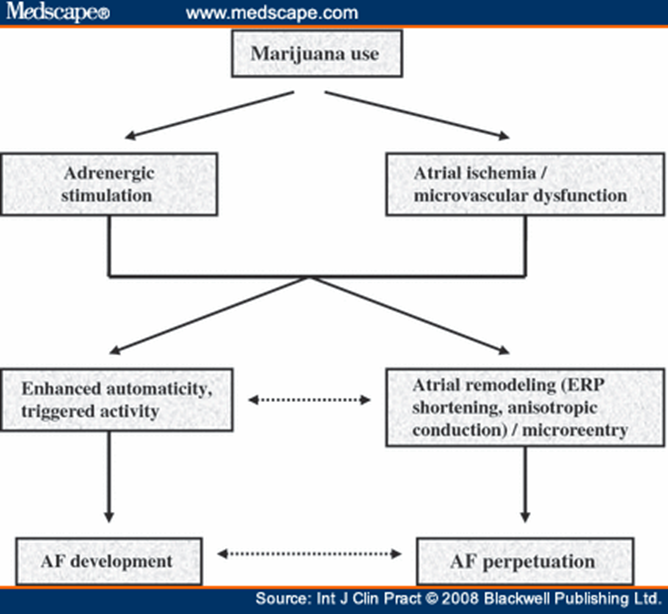
Proposed pathogenesis of marijuana-induced atrial fibrillation. AF, atrial fibrillation; ERP, effective refractory period[ref]IBID[/ref].
From above you can see the author’s proposed model that helps to explain how AF could develop in a marijuana user. AF is a serious disorder which needs prompt medical attention.
To confuse the issue, which is what medicine is all about, many users may in fact be experiencing transient episodes of AF and never know it. But the exact incidence of this disorder is completely unknown at this time. Frequent cannabis users report “palpitations” on numerous occasions but they could be due to sinus tachycardia, AF, PVCs (premature ventricular contractions see section three), or some other as yet to be described dysrhythmia.
The authors also state that the euphoria from marijuana may mask the disconcerting events going on in your chest. Lastly, since pot is still a “dangerous and illicit substance of abuse” many people who might experience a real episode of AF or multiple PVCs may never see a doctor out of fear.
I personally know that this was the case when I was living in Santa Cruz, CA. Here many chronic users came to the Chinese medical clinic for acupuncture knowing they would receive a more sympathetic ear to tell their tales of palpitations.
WHAT TO DO
Now, if you do indeed experience a racing heart rate the first thing to do is get the rate by feeling your pulse on the radial artery on the wrist. Measure it for 60 seconds. That will be your heart rate-simple right?
The normal range of heart rate is about 75 give or take 10 beats on either side. But smoking marijuana clearly increases your heart rate so it might be closer to 100 or more in the apprentice pot smoker. This is called sinus tachycardia and it’s essentially benign. The only problem is that you cannot tell what type it is unless you have an EKG (ECG for you newbies) handy. Interestingly, should your dog get into the brownies he or she will experience bradycardia (a slow heart rate), not tachycardia.
Or you may be having palpitations. The true definition of palpitations is an uncomfortable awareness of your heart (beating). It’s not a true medical term anymore. You may also experience occasional extra beats (premature ventricular contractions, PVCs, ectopy) where you feel your heart flip-flopping; this is what patients often times erroneously call palpitations, but it’s so common that I use the terms interchangeably. Some patients with AF may report having palpitations too.
The impact of marijuana smoking on clinical arrhythmias has not been well studied. Palpitations are commonly experienced after marijuana smoking and are usually ascribed to the sinus tachycardia or more rarely to premature ventricular contractions… Petronis and Anthony, in a large epidemiological study, clearly showed that marijuana smoking is independently associated with increased incidence of palpitations, although the underlying cause of this finding was not clarified[ref]Int J Clin Pract. 2008;62(2):308-313[/ref].
Under rare circumstances you may actually be suffering from angina or a heart attack as seen below:
Interestingly, case reports describing a temporal association between marijuana use and ventricular arrhythmias often implicate myocardial ischaemia as the underlying cause [ref](Int J Cardiol 2005; 104: 230-2. Ann Emerg Med 2003; 42: 365-9)[/ref].
But that would be exceedingly rare, and it most likely would happen to those with known cardiovascular disease.
In conclusion, there are several fast heart rates (sinus tachycardia or AF) and strange sensations (PVCs, palpitations) that marijuana users report usually within the first 90 min of partaking in the cannabis experience. Normally this is of no consequence in young, healthy persons with the exception of AF. Because of the dangers inherent in AF, do not simply assume that your racing heart is of no consequence, that’s called denial.
Should the rate be excessively fast (over 125), sustained for over one hour, or you experience chest pain, lightheadedness, nausea or vomiting it may be signs of something much more serious.
Under those circumstances, the most prudent thing to do is to visit your friendly neighborhood emergency department just to be on the safe side. There they can quickly administer an EKG and “see” what type of cardiac problem you are experiencing. Aside from the fleecing you will receive on your pocketbook (US only of course, not the UK), you will at least be able to sleep that night knowing that you are not one of the few suffering from this dangerous disorder called AF.

Harm Reduction in the Use of Marijuana - Atrial Fibrillation
Harm Reduction in the Use of Marijuana – Atrial Fibrillation
When we compare smoking marijuana to the other “drugs of abuse” we usually give pot a big thumbs up, and paint it in a positive light. And for good reason, marijuana is incredibly safe. Pot’s worst side effects don’t seem worse than tripping over one’s shoelaces, unless you prefer hiking in a Cambodian mine field.
Understandably then, we all tend to gloss over the occasional “chicken littles” of scientific observation when they become known. Such as the much-ballyhooed increase in heart attack risk within one hour of smoking weed. I dispatched that threat quite readily in a previous article. It reminded me of the hit piece, back when people were wearing bell-bottoms, when some malcontent claimed that LSD caused chromosomal damage to users. The article was debunked a week later but there was never a correction issued in the newspaper.
However, substantial evidence is accumulating that smoking marijuana may indeed have a short list of adverse effects that we all need to be aware of, especially young kids experimenting for the first time.
Marijuana’s cardiovascular effects are not associated with serious health problems for most young, healthy users, although occasional myocardial infarction, stroke, and other adverse cardiovascular events are reported. Marijuana smoking by people with cardiovascular disease poses health risks because of the consequences of the resulting increased cardiac work, increased catecholamine levels, carboxyhemoglobin, and postural hypotension[ref]J Clin Pharmacol. 2002 Nov;42(11 Suppl):58S-63S[/ref].
THE DANGERS
The last sentence restates the obvious talking points on marijuana side effects: pot increases blood pressure (only when lying down) while it stimulates the “fight or flight” response-causing tachycardia, a small increase in heart rate. A trivial amount of the oxygen-carrying molecule hemoglobin binds to the by-product of combustion, carbon monoxide (CO), to form carboxyhemoglobin. Carbon monoxide, a poisonous gas formed from combustion of carbon containing materials, is the same substance fashioned from burning charcoal on a grill which is one reason why you cannot light up your Weber Grill in the living room, the other reason is obvious I hope, as any personnel from the LA County-USC burn unit will testify-myself included.
CO is formed from smoking cigarettes or pot too. It can, in larger quantities, impede oxygen transport by competing for oxygen binding sites on hemoglobin. Is it clinically significant? I think not unless you already have underlying cardiovascular or lung disease such as COPD.
Lastly, the postural effects of pot are dizziness when you stand up too quickly. It’s called orthostatic hypotension. Be careful here as people have fainted from this. You can help prevent orthostasis by staying well hydrated, no gin is not a hydration medium, drink water and fluids that behave like water! A little trick I learned as an avid trekker is to put a big pinch of salt in each quart of fluid. This helps keep water in your vessels where it’s needed. Now let’s discuss a more serious problem.
ATRIAL FIBRILLATION (AF)
In particular for kids, err, young adults experimenting with pot, honesty is the best policy so let’s begin with a frank discussion on the cardiovascular system as it pertains in particular to heart arrhythmias (palpitations). In a separate piece I’ll review stroke risk.
A study was completed recently that tried to address the incidence (the number of NEW cases in a given population) of a certain dangerous rhythm disturbance called atrial fibrillation from the use of pot.
Atrial fibrillation (AF) is actually a very common disorder among those with known heart disease, heart failure, or hypertension among other conditions. It is characterized as a fast heart rate, very fast sometimes, with rates well into the high 150s or higher. It is not benign. It can lead to stroke and numerous other serious complications, including cognitive decline.
The question I always ask patients is this: “does your heart sometimes feel like a trip hammer or does it feel like a bird is fluttering in your chest?” Occasionally, severe chest pain may accompany it in those with heart disease.
In the next segment we’ll discuss what a team of researchers discovered regarding AF and its relation to marijuana consumption.